Sunday, April 28, 2013
Mumbai crowds understand their cricket, Virat!
Sunday, May 15, 2011
Mafia Queens of Mumbai: Stories of Women from the Ganglands: S. H. Zaidi and J. Borges
The stories of the wives of Dons are even more fascinating. They all took active interest in their respective husband's work, once they were on the run. The dons trusted their businesses in the hands of their wives. And these clever women learnt the ropes quickly and also realised how to protect their husband from harm. The likes of Asha Gawli and Neeta Naik joined politics to ensure their husbands, Arun Gawli and Ashwin Naik respectively, aren't gunned down by the police. While some others joined their husbands in their flight from law.
More such stories, some fascinating, some sad, find place in this book. It is worth grabbing a copy and driving through the untold stories of the Mumbai underworld. Certainly, crime is much more fascinating to read.
Friday, October 15, 2010
Maddened by doughnuts
The place is nice, and like the usual coffee parlours, the ambiance is definitely targeted towards the youth. They have a huge variety of doughnuts, ranging from chocolate dipped to pineapple flavoured ones. And they have a few good offers. Like, buy nine doughnuts, get three free. And combo offers for less, etc. But, ever since reading Predictably Irrational, I feel these offers are not genuine ones, but decoys to induce us to buy more. And, there is a problem. All their doughnuts are excessively sweet. I ordered a dark-chocolate doughnut. Now, my near and dear ones would know about my weakness for dark chocolate. I like it, because it has that bitter tinge to it, which leaves me craving for more. It has more of cocoa and less of processed milk. And I like to believe all those studies that say dark chocolate is good for health. But, alas!! This dark-chocolate filled doughnut is sweeter than the regular milk chocolate. So much of sugar into it, that I didn't need to have sugar the next day! Thankfully, I did not have any sugar test scheduled, else the doctor would have surely declared me diabetic.
Here we are, paying between Rs.40-45 for the doughnut, and yet we get the stereotypical sweet chocolate doughnuts. Why? Because Indians like their chocolates to be sweet. But then, they are charging a premium for those doughnuts and they need to break the stereotype. Hope M.O.D. realises this and improves its dark chocolate doughnut. I would definitely go there once again, if they make that correction.
Sunday, August 29, 2010
Idli House
Top this sumptuous breakfast with a piping hot filter coffee and you are done. The only thing remaining is a nice bed to lie down and digest all that delicious food.
Wednesday, June 09, 2010
Bombay Blood Group: A rare and interesting one
The Bombay Blood Group is a rare blood group, called so because it was first discovered in Mumbai (then Bombay), by Dr. Y. M. Bhende and his co-workers around the year 1952. This study of theirs has been published in the medical journal Lancet. It is estimated that only 1 in 2,50,000 people are of this blood type. If regular blood testing methods are used, this group type gets classified as belonging to the O-type. That is because they are neutral to reactions related to both, anti-A and anti-B antibodies. This, typically ends up classifying the blood as O-type. However, this category of blood, does not contain or produce the antigen-H, which is found in O-type blood. The blood type gets detected only by cross-matching with other O-type bloods, where blood from the Bombay blood group will show incompatibility to the O-type blood group.
People with such blood can donate blood to anybody (all ABO type), but can receive blood only from their own type. Therefore, if you know anybody who belongs to the Bombay blood group type, ask him/her to contact the NGO, Think Foundation which tries to maintain a database of people of the Bombay blood group.
Saturday, May 15, 2010
Ripping the Fabric, The Decline of Mumbai and its Mills: Darryl D'Monte
Darryl D'Monte's book is a refreshing change. D'Monte takes a holistic view of what caused the decline of Mumbai's production industry. The only problem (probably) is that D'Monte focusses on what has been done to make use of mill land, now that the mills have closed down. So, for those who are looking at what has been the effect of the 1982 strike on workers' lives, you will be disappointed.
D'Monte points out all that was wrong with the government- both state level and central-- policies that triggered the downfall of the manufacturing industry in Mumbai. He points out that the socialist India's policy of promoting handloom and cottage industry was the starting point of declining of mills. Organised mills, like the ones in Mumbai, were placed with restrictions that didn't allow them to compete freely in the market. On the other hand, unorganised powerlooms sprung up in the villages as cottage industries, which didn't have workers' unions, and used government policies to undercut the mills. Coupled with this, was the Maharashtra government's policy to not allow mills to expand but ask them to setup industries in the backward areas to develop those places.
Then, there were the mill owners, who did not reinvest the profits they earned, for modernising and improving productivity of the mills. Instead, they gave way hefty dividends to shareholders (of which, they were the largest). As time went by and as machinery became technologically backward, it made economic sense for mill owners to shut it down and sell off the land.
And last of all, the political parties. In 1946, the Bombay Industrial Relations (BIR) Act ruled that there would be only one union, the Rashtriya Mill Mazdoor Sangh (RMMS), that would be allowed to represent all the mill workers. This union went into the control of the Congress, which was the ruling party of the day. And slowly, corruption crept into the union and union officers started colluding with the mill owners. D'Monte highlights the case of Khatau Mills, where the owner, Sunit Khatau, engineered the defeat of sitting mill president and brought in a person of his choice. This was done so that the new president would consent the sale of the mill's land in Byculla and Khatau would restart the mill with a reduced number of workers.
Now that the mills were closed, and the government and mill owners not interested in getting it started, what can be done with the mills? The mill redevelopment policy came in too late. By that time, even genuinely interested owners had lost the zeal to restart the mills. D'Monte goes into details of all the studies- official as well as unofficial- that have been done to make use of the mill land. Mill land measures upto 600 acres, and that too in the heart of Mumbai, most of it in Lalbag, Parel. He points out how different studies recommend using land for setting up convention centres, five-star hotels, hospitals, developing commercial spaces and open public spaces. The money from the proceeds were to be used to pay the workers. But, most of these plans do not address, what can be done to restore the workers' jobs? Only a few mention using the mill buildings to run non-polluting industries, where workers should be re-trained to take such jobs. The book points out to the rise of the underworld, which found its foot soldiers and bosses from the ex-workers in the mills. With no jobs coming their way, they joined the underworld to make money and help families survive.
D'Monte also describes the unscrupulousness of the mill owners, who twisted the redevelopment policy to make money out of selling the land. Like showing that they didn't have 15% open space and selling the land off. Then, demolishing a few buildings and selling it off further. Phoenix Mills owners, the Ruias, even went to the extent of setting up a bowling alley and spa in the mill compound, after telling the BIFR that, it was the workers who have demanded these 'recreation facilities'. Naturally, workers are angered by such plans , as the areas that they once worshipped as their workplace, were being turned into amusement and entertainment areas. And they didn't have any place in these plans.
D'Monte closes with what can be done about the docklands in Mumbai, which too occupy large swathes of lands that may come up for development. He points out that since this land belongs to the public (government), there should be an all inclusive plan to develop it. Left to the market forces, this would see nothing but commercial structures and high rises for the rich coming up in the place of the docks. While this has happened with the mills, something needs to be done to prevent further use of land by speculators and realtors. The public needs to have something for it as the government has doled out enough concessions to all the industries in Mumbai.
After reading this book, we realise that the mill workers were least responsible for closure of the mills. It was a lethal combination of flawed government policy on priorities for industries, unscrupulous mill owners, corrupt union and politicians tying up with the mill owners to grab their share of the pie in the mill land. The hapless worker became a mere spectator in the bigger game for the mill lands.
Wednesday, May 05, 2010
It happens only in India
The best way to gather people in IIT is to send out earnest e-mails to seemingly interested parties. With the existence of mailing lists, it is even more easier to do that. So, on her request, I sent out an e-mail to all the PhD students in IIT and also sent a separate mail to the students of Chemical Department. And lo! More than forty people responded to the e-mail and participated in the survey. Just on the basis on an e-mail. People who didn't know me or the student or haven't met either of us, went to participate just because they were either curious or genuinely interested in helping the student.
But, this very attribute, the student says, is a problem when she would be collating her results and publishing them. She says that foreign reviewers fail to understand how is it possible for people to participate in a survey, if there were no incentives offered to the participants. They are just not able to digest the fact that people came to the survey only because they were curious about the content or they actually wanted to help her with her research work. And that is because, in foreign universities, especially the ones in US, Canada and Europe, it is common to give incentives to people to participate in surveys. Their claim is that people respond only to incentives and therefore it is hard to believe that more than two hundred people participate just on the basis of an earnest appeal.
I guess, this is what is Indian culture. Helping out even without thinking of the incentives. All participants were helping the student with her research work when they participated in the survey. And they have done it without considering the benefit involved as it wasn't anything like an IQ test, where the results can be used for bragging about self. And perhaps that is why we saw no riots during the July 2005 floods in Mumbai. It was the opposite. Residents in low-lying areas helped everybody stuck in the floods. There were people stranded on roof-tops of BEST buses, who needed to be evacuated. Before the government could swing into full action, it was the work of these individual citizens that saved so many lives. This is in complete contrast to the aftermath of the Katrina hurricane, which saw so many food related riots in Louisiana.
As the Shilpa Shetty-Govinda song goes- "It happens only in India!!"
Monday, February 15, 2010
It's a rage out there!
I geared up for the drive on Delhi's wide and smooth roads (of course, this is the new part of Delhi). And I was in for a shock. The mentality of drivers narrows as the width of the road increases. Changing lanes without warning, drastically reducing speeds at will, cutting through lanes to make that left turn, it is a rage out there! To top it up, the local transport buses execute heart-stopping overtaking maneuvers. Drivers always have to be on their toes, trying to out-guess all the drivers driving just ahead, besides and just behind them. It is like plotting those political moves just to retain your chair!
And through the day, I kept observing the similar pattern of Delhi's traffic. While travelling aboard a DTC bus (the new low-floor buses are too good and well-lit, compared to the regular ones) the driver was out to show "who's the greatest of them all" and managed to bully a few Maruti 800s and Indicas. It is in the best of your interests not to venture near any passenger carrying bus in Delhi. There is a saying, "Dilli, dilwaalon ki!!", but only for those with a strong heart.
Cut to Mumbai. Lane changing, lane cutting does happen. But in a civilised manner. The drivers do have some consideration for their brethren. A driver will either signal or gradually slow down before making a lane change. The change is not sudden, but a gradual, even if there is no indicator given. The rage is there, but is more considerate and moderate. That, I guess is the spirit of Mumbai city!
Friday, December 04, 2009
Mani's Lunch Home
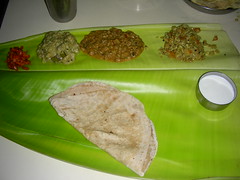
I had also heard about Mani's Lunch Home in Matunga, but had never been there. When I searched on the web, I came to know that it is the first and oldest authentic Aiyer restaurant in Mumbai. Of course, it had to be in Matunga. They have come up with branches later, but began in Matunga. And, on one fine Saturday, Hari persuaded all of us to go to Mani's to savour the authentic Aiyer food. And we had a meal of our life. Served on a plantain leaf, in traditional Aiyer style, the food consists of the typical South Indian menu of dry vegetable, curry vegetable, pickle, papad, curd, butter-milk, sambhar, rasam and rice. And it goes without saying, that you can devour in as much quantity as you can. As it is a very busy restaurant, the food served is always hot. The chapatis are served fresh off the pan. The sambhar and rasam have a typical Aiyer taste to it. They source the rice from South India itself. The kind of rice used in the restaurant is not native to Maharashtra. But, it is a nice variety and the rice is well cooked and has a soft, spongy feeling to it.
Having Hari with us, gave us a language advantage. Hari used all his knowledge of Tamil language to get us an express seat and good service. Otherwise, the service standard in Mani's is not as good as Rama Nayak. Of course, we were first timers in the restaurant and patrons must be getting better treatment. But then, they also have to focus on converting first timers into patrons. That they cannot do only by serving good food. Sometimes you are kept waiting for the next serving of vegetables and sometimes you are deluged with the waiters wanting to serve you.
But overall, Mani's was a satisfying experience. We ate so much that it would have been very nice to have an acquaintance in Matunga. We somehow managed to get back to IIT. That to we took a rickshaw from Kanjur to the hostel. And in the hostel, we slept soundly for more than an hour. The evening saw us having very less dinner, as we were still savouring the tastes of Mani's.
Sunday, November 01, 2009
For the love of Khadi
I was impressed by the make and the look of it. It was a kurta-payjama set and it appeared very nice and elegant. It was then, that I decided to try out Khadi wear. My friend informed me that Khadi outlets offer 20% discount on their products in the week following Gandhi
It was a rare occasion when I shopped liked a shopaholic and bought kurtas for myself, my brother and my father. I've bought something for my mother, but have kept it a secret from her. I will be surprising her with that gift. Kurtas ranging from the traditional styles to modern contemporary styles, they were all there. Ties made from Khadi silk, cotton and silk sarees, shirts and a lot more. If you do not like the ready mades, you have an option of buying the cloth and then getting it stitched as per your style. And they don't cost too much. I got a cotton kurta for around Rs. 220/- after discount! And short kurta for daily wear at around Rs. 120/-. That, I would say, is damn cheap. And the comfort level in these clothes is awesome. You have to trust me on this, because I have been very choosy about what I wear. Some of my shirts are just lying around because I don't feel comfortable wearing them.
This trip to the Khadi Gramudyog Bhavan has converted me into a Khadi fan! I have just begun to love Khadi. And, the best part is that it is completely indigenous wear. We are encouraging small and medium entrepreneurs and also sustaining and creating jobs at village and town levels. That is what is more encouraging, apart from having good quality clothes to wear. Yes, Khadi Gramudyog does have good quality control checks. Now, I've planned a revamp of my wardrobe and have decided to slowly stock it up with Khadi! My swadesi movement has begun here.
Saturday, October 10, 2009
Leopold Cafe
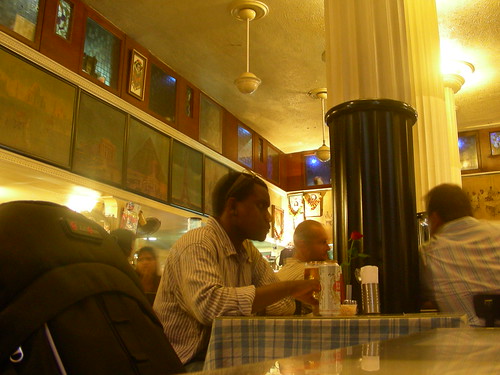
The restaurant has two levels. On the ground floor (the photo of which is shown above) they serve food and only beer. Whereas a full fledged bar is located on the first floor. We were on the ground floor enjoying the beer. They serve various kinds of beer, ranging from draught ones to foreign brands. And, they serve beer in a glass which bears the beer company's label. E.g., a Kingfisher beer, is served in a glass with a Kingfisher label. It is priced reasonably, c
Expect a crowd at any given time, and also expect to see a large number of foreign nationals in the restaurant. You might feel as if you are in a bar on Heathrow airport, where a large of of people of various nationalities converge. On the service side, it is good, but not good enough. The waiter has to attend so many tables and so many orders, that he might get stretched. So, you might find yourself waiting to place your order or waiting for your order to be served. The beer is served chilled, so absolutely no problems about it. And the waiter does give his suggestions to make our experience better. All in all, a wonderful place to be. Not without reason, that Leopold is popular amongst the people of Mumbai.
Monday, September 21, 2009
A. Ramanayak Udipi
A. Ramanayak Udipi restaurant is one such restaurant in Matunga. It is situated right next to the station, on the eastern side, thus giving it a crucial location advantage. The restaurant serves only lunch and dinner, and the cuisine is authentic Udipi cuisine, with a touch of Maharashtrian habits. So popular is the restaurant that on Sundays and holidays, the waiting time at the restaurant exceeds one hour. The food is served on a banana leaf, giving it a traditional outlook. The meal consists of three vegetables (two gravy-based and one dry), curd, butter milk, chapati or puri, sambhar, rasam, papad and most importantly rice. And except for the curd, everything else is unlimited in amount. You can eat as much as you want. The waiters who serve there do not stand on your head pushing you to eat fast. You can eat at your own pace. The waiter serves you whatever you need at your call. Thus, you don't keep staring at an empty plate (or empty banana leaf) before you are served. The food has a distinct coastal flavour. The vegetable preparations are in coconut oil (though they are not too oily) and are not spicy, but neither bland.
The chapatis and puris served are hot and fresh off pan. Never have I been served anything that is off the stove more than 10 minutes ago. After you have filled yourself to the heart with chapatis, you should definitely have sambhar/rasam rice. No South-Indian meal is complete without this. And if you still have space in your stomach, top it up with curd-rice.
The restaurant has been functioning since 1942. They have now opened other sister concerns, for e.g. Idli House on King's Circle. But this restaurant remains their flagship. The service here is prompt, but there is no rush in serving. Neither do they want you to rush through your meal. As of September 2009, this meal costs you Rs. 90/- only. The prices are bound to be revised, considering the changes in the costs of eatables. The only problem is how do you carry yourself home, through the Mumbai local, after such a hearty meal?
Wednesday, July 01, 2009
Leaderless India?
An engineering marvel like the Sea Link should have been inaugurated by someone who holds a Constitutional post. The President was in Mumbai two days ago, she could have done the honours. Or the Prime Minister, who is the captain of the team that shapes the nation's future. But no, the government of Maharashtra felt that Sonia Gandhi has a standing that is higher than the President or Prime Minister. But, we have not protested against this. We are silently accepting all this. Why is there no protest? Why aren't there any protests visible? If the BJP would have called the RSS chief to inaugurate such a facility like this, imagine the uproar that would have taken place. But then, Congress is secular, while BJP is communal.
And the old wily fox, Sharad Pawar, also an off-shoot of the Congress culture sucked up to Sonia Gandhi and requested Chief Minister Ashok Chavan to name the bridge after Rajiv Gandhi. The CM, being a second generation Congressman, promptly agreed to the suggestion, in a bid to please his 'high-command'. The arguments put forward by Sharad Pawar to support his request were equally ridiculous. He said that Rajiv Gandhi was a 'son-of-the-soil' as he was born in Mumbai. Rubbish!! Mr. Pawar, are you forgetting the other leaders who have worked tirelessly for the benefit of the state of Maharashtra. Those 105 people who were killed when this very Congress wanted a bilingual state of Gujarat and Maharashtra have contributed more than Rajiv Gandhi. The only thing that I agree about Rajiv Gandhi was that he ushered in a technological revolution and had recognised the necessity of modern technology. But, he is the same Rajiv Gandhi who infamously agreed to amend the constitution to annul the Supreme Court's judgement in the Shah Bano case. He is the one who made the statement 'when a big tree falls, the earth shakes', thus backing those Congressmen involved in the anti-Sikh riots.
I would say, there were more worthy leaders than Rajiv Gandhi after whom the bridge could be named. Going back in history, there is Kanhoji Angre, the famous commander of the Maratha fleet. He tormented the English and Portuguese with his attacks on their ships. Since this bridge crosses the sea, his name should have been a favourite. Then there were Lokmanya Tilak, Acharya Atre, Shankarrao Chavan, Yashwantrao Chavan, Ahilyabai Rangekar, C.D. Deshmukh, and many more from politics. J.R.D. Tata from business. Homi Bhabha from science. Tata and Bhabha have been pioneers in their fields. Air India was Tata's baby. Homi Bhabha kick started atomic energy research. Both were Mumbaikars. There are many more social activists, famous cricket personalities, litterateurs who have contributed to the well-being of the people of Maharshtra. Anyone of them could be chosen. But no, the Congress doesn't know anybody beyond Nerhu and Gandhi. Thankfully, they aren't naming anything after Sanjay Gandhi now-a-days.
An India that dreams of becoming a super power, doesn't look at leaders apart from the Nehru-Gandhi family as worthy to be remembered through engineering and technology marvels. This picture doesn't look good. Though, it would have been nice if the sea-link was simply called Bandra-Worli Sea Link.
Wednesday, June 10, 2009
Cafe Britannia & Co.
Tucked in the business district of South Mumbai, is this very old and famous restaurant called Cafe Britannia & Co. As is the case with the early restaurants of the city, this too is owned by a Parsi family. Established in 1923, Cafe Britannia is located at Ballard Pier, a walking distance from Chatrapati Shivaji Terminus (CST).
The restaurant is famous for its Parsi/Irani style of non-vegetarian food. I happened to read about it in a newspaper. Although, what I read was sad. The restaurant owner, an old Parsi uncle (surname Kohinoor), has decided to close down the restaurant in due time. His sons, are not interested in running the place as both have settled abroad. They wanted him to shut down the place, but he coaxed them into keeping it running till he is alive.
One limitation of this restaurant is that it is open only 12:00 PM-4:00 PM Monday-Saturday. So, it is a disadvantage for those who cannot make it for lunch to this restaurant. What I do not understand is why did they not change with time and keep it open for dinner as well. With Ballard Pier being an business area, it probably might not have been feasible. Whatever the reasons, I went to this place, so that I can peek into their cuisine before they shut down. Since traveling alone to CST all the way from Powai is too boring, I tagged Sushant along with me. Sushant thinks that I am a person who has nothing to do, except taste food at various restaurants and then blog about it. But then, he is a sincere companion and gives sincere reviews. Sometimes, he manages to suggest some very good restaurants. If you manage to reach CST comfortably, then reaching this place is a breeze. It is located in the lane next to the New Customs' Office. You cannot miss the huge board of Cafe Britannia & Co.
They serve non-vegetarian food only. And it is classical Parsi/Irani style of food. This place is a delight for those who love non-veg food. The restaurant seating arrangement is spartan, like most Irani restaurants across Mumbai. Even the table fans are so old, you suspect whether they've been ever changed after being first installed. The food, is not spicy at all, so you can enjoy it without worrying about the after effects.
Here, I had the chicken dhansak for the first time and I loved it. Served along with brown rice, the dhansak tastes awesome. But, Cafe Britannia is
At the end of the meal, I told the restaurant owner that we had come all the Powai to taste his food. He was the son of the old Parsi uncle, and was overwhelmed by the fact that we had taken the efforts to come this far. This guy has good PR skills. Every customer going out was greeted with thanks and come again, the more familiar ones were asked about their and their family's well being. And the patrons of the restaurant actually took time out to chat with him on any possible topic on earth.
Now, about the service. If the waiter takes too long to take your order, old Kohinoor uncle rushes down to note it. The time taken to serve you is not too much and you can eat at your will. No waiters overlooking you and asking you every five minutes, "aur kuch chahiye, sir?" The quantity is good enough and the taste is typical of Parsi/Irani cooking styles. The charges are a little bit on the higher side, but then, it is fine, once in a while. The chicken berry pulao cost us Rs. 240, while the chicken dhansak was Rs 200. Each dish serves good enough for one person. So, you can order two-three dishes and share between yourselves.
The sad part is, this restaurant may close any time, that is what the owners have declared. The only hope is that they franchise this out to somebody, with conditions that the same menu and ambience be maintained, but with extended timings, so that those millions of Irani food fans can savour the berry pulao for years to come.
Friday, May 01, 2009
Sardar's Pav Bhaji
Every pav-bhaji variety is garnished with Amul butter, hence every dish begins with the name "Amul XYZ Pav Bhaji". The outlet serves lip-smacking pav bhaji. In the evening, you can notice the cook making pav-bhaji in the adjacent room. The huge tawa is placed on the side bordering the entrance of the hotel. Hence, you can see all the preparations going on.
For those who are calorie-conscious, don't even try to enter this hotel. At the entrance itself, you'll get a heart attack. On the hugetawa, along with the bhaji, the cook adds dollops of Amul butter. At home we use a spoon or butter knife to scrape the butter. Butter the cooks here use large "karchi " to drop butter into the bhaji. Apart from that, he adds almost two table-spoons full of butter to the bhaji before serving it to you. Add to this, thepav (buns) which are also sauteed in butter.
But the taste is awesome. You are extremely full with one plate pav-bhaji. And also with the guilt of consuming tons of butter. But don't worry, you can always exercise a bit extra the next day to get rid of the accumulated fat.
Tuesday, July 08, 2008
Students' protests at IIT
Such has been the selection procedure at IIT, that despite a shortage in the number of faculty, they are not hiring any Tom, Dick or Harry. Now, when candidates are hired just because they have a caste certificate, and not enough credentials to match the rigour of work at IIT, it will naturally lead to a drop in teaching standards. A student who enters IIT may inflict harm on just himself/herself, if he /she doesn't manage to cope up with the curriculum. However, if a teacher who doesn't meet the IIT mark, comes in to teach, he/she causes harm to entire generations of students. And if IIT is not in a position to terminate the services of the teacher, then around 35 batches of students are likely to suffer. While it is acceptable for a trainee to be of standards that may be a tad below par, you cannot accept at trainer whose skills are below par.
The Minister of Human Resource Development should understand that not everybody is cut out for every possible task. Allow the under-privileged to find their core competence based on opportunities provided to them during their training. Please do not let them occupy positions just because they have a caste certificate. No person with below-par skills should be allowed to be at a position from where he/she has a potential of damaging various careers.
Monday, October 15, 2007
Down the city's history lane
The hamlet of Khotachiwadi has not as yet been declared a heritage structure. Individual homes have, however, been given heritage status. This means that the powerful builder-lobby can force residents to sell their homes, so that high rises can take their place. The area of Girgaum is a prime area in terms of real estate, where the ongoing rates are more than Rs. 20000 per sq. ft. The houses in Khotachiwadi are very old and therefore require a lot of maintenance, which costs. Also, most families residing in Khotachiwadi are senior citizens, whose children have moved to other cities to pursue their career or into their own homes. Thus, many houses get sold off, because the owners are themselves not interested in residing there.
The residents of Khotachiwadi have come together to form an association (The Khotachiwadi Heritage Trust) that works to preserve the identity of Khotachiwadi. The association functions from the Ferrera house, which acts a headquarter for the association. The Ferreras have also preserved many antiques from the yester years. The association has been organising the Khotachiwadi festival every year, since 2005. The festival is The festival aims at bringing awareness about the Khotachiwadi and introducing the new generation to this fabulous heritage of ours.
The Khotachiwadi needs the support of the citizens of the nation in order to preserve itself. We need to rise to the occasion and thwart every attempt of erosion of the Khotachiwadi. However, nothing much can be done against the will of individuals. If an individual decides to sell the house based on his/her free will, we cannot interfere. But the society can support the attempts of those individuals who intend to preserve the heritage. The hamlet can serve as a good model for functional existence as well as building houses that give a sense of living. It keeps reminding us about co-existence with nature and the ability of our forefathers to build communities that are social, but still provide for the requisite privacy of the individual.
Photos of Khotachiwadi can be found over here.
Saturday, April 28, 2007
Mumbai Restaurants: Part 1
Ram Ashray Udipi Restaurant
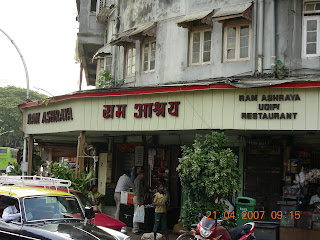
Located off Matunga railway station (Central Railway). Get out of the station on the eastern side and walk towards King's Circle. The restaurant is a two-minute walk from the station. Authentic Udipi cuisine for breakfast. If you go there on a Sunday, beware. The rush hour starts pretty early. The restaurant gets crowded and even if you are two people, you may have to wait for at least 15 min. But, I guarantee the wait is worth it.
Once inside and seated, do not expect a menu card, they don't have one. So, you either ask the waiter what's on the menu or just rattle off your order. While every dish served is awesome, I would personally recommend vada-sambar and onion uttappa. The sambar and chutney served are amazingly tasty and the good part is that you are served as much as you ask for, at no extra charges. The dosa preparations are a bit oily, but the dosas have a thin crust and are very crisp, an indication of a good preparation. Now, since breakfast always ends with a hot beverage, and this being a Udipi restaurant, do not forget to have coffee. This is not the regular nescafe, but it is filter coffee made in the tyipical Udipi style. And the cost of all this, not too much. A breakfast consisting of one plate idli-sambar, one plain dosa and a cup of coffee is just Rs. 35/-
Once you are done with your breakfast, you can sign-off with a 'pan' placed at the cashier's desk. And, while going back, do not miss the weekly commentary by Nana Chudasama, put up on the banner in front of the restaurant. The day I visited the restaurant, the banner was as shown below-
Thursday, June 09, 2005
Last month @ IIT
Now, for my project. I hope to complete the report by Jun. 20th. Defend by Jun. end. And then I'm a free bird. Will go back home for a few days and then join GE on 18th Jul. Mother is so worried that she has started contacting everybody she knows in B'lore to make temporary arrangements for me. Now, some one tell her that even GE would be glad to help me ;)
Rajul was in IIT yesterday. It was her b'day. Well, she hadn't come 'coz it was her b'day but she was in Mumbai for her summer project, and had come on campus to meet her boyfriend... And since I was also there, she met me too. She become much more gorgeous than she was in school... I just forgot to wish her happy b'day when she came in front of me!! Boy, that's bad thing to happen. We (me, she and her boyfriend (Vivek)) had a nice time @ coffee shack and then she gave us a b'day treat at Baskin Robbin's. Oh God, this ice-cream has f****d my throat since then.
I guess that's it for now. Hope to get back to work.... This net usage is now going to decrease as no more 24 hr net connection in B'lore.
Tuesday, May 24, 2005
Hostel valfi, new format, et al.
Just the next day, we submitted an abstract to AIChE conference. Hope this stuff gets accepted. Could give me a huge boost in terms of a Ph.D. admission in the US. Recently, the new format for M.Tech. thesis submission was announced. We feel that Prof. Preeti has written the regulations and guidelines. It is visible from the statements where it is said - "Your guide is the best person to advise you on these matters, since she is experienced in writing and reviewing papers." God, I didn't know so many guides were females!! Had this been the other way round, there would have been a cry of gender discrimination. Also, I do not know how many guides from the Chemical Engg. Dept. are reviewers for international journals. Of course, they have a good command on English and writing (most are US returned, hence their GRE should be of help).
My M.Tech. project work should be complete by this weekend. I'm taking a leave for 3 days, as my guide recommened it. Then, when I return, I'll begin with report writing. Should be easy, as I've completed one part of it already and the remaining shouldn't be difficult to complete.