Showing posts with label review. Show all posts

Tuesday, October 22, 2013

India After Gandhi: Ramchandra Guha

After a pretty long time I am writing about a book. India After Gandhi, by Ramchandra Guha, takes us in the era, which history books in school end at. For most of us, India's history ends with Nehru's famous tryst with destiny speech and the assassination of Mahatma Gandhi. But, in reality India's history as a nation, begins from 1947, when her existing boundaries and shape came into being.

The book talks about all the major events that have shaped the present situations in the country since 1947.
The enormous tasks and challenges presented by the independence, partition and the British mandate to the princely states of being free to join either union or declare independence from both. The country's first cabinet faced challenges from different directions at the same time. These ranged from rehabilitation of those displaced by the partition; uniting people who were divided along all imaginable lines like religion, caste, language, territory, etc.; presenting to the country a set of rules and regulations that would govern them with fairness and most important of all, food and shelter. 

The book very nicely describes the way Nehru's cabinet negotiated through the amazingly complex maze and labyrinth. Negotiations, persuasions and debates were the only ways used in resolving almost all disputes. Guha describes the challenges faced by the constitutional assembly and the bureaucracy in turning the nation into a democratic society based on universal adult franchise. With the benefit of hindsight that we now have, the book makes us realise how fortunate we were to have leaders of the calibre of Nehru, Ambedkar, S. P. Mookerjee, J. B. Kriplani and others. Nehru's staunch belief in democratic process meant that many of his favourite ideas and views were critically debated and he was constantly ready to accommodate the concerns of the opposition too. Several proposals of his were modified and watered down but each was fiercely debated in Parliament.

The country has never been without challenges. Right from independence, there have been movements aimed at seceding from India, external invasions and internal troubles. The book talks about some of the successes and failures that the nation has seen in this regard. It also talks about the way India went on to build its economy and the push and pull from within about the direction of the development. As we read the book, we realise how leaders with strong grass root connections can actually give a good shape to discussions and debates on various issues. Of course, this has its pitfalls, like Indira Gandhi responding to the masses' disappointment with her infamous garibi hatao slogan. One of the most glaring examples of not being connected to the masses and acting on suggestions of coterie is that of Rajiv Gandhi reversing the Shah Bano judgement and then opening the locks of the Ram temple/Babri masjid in Ayodhya.

Guha also talks about the statesmanship of opposition leaders like J. B. Kriplani, A. B. Vajpayee amongst various others, which sort of makes the reader a little sad when compared to the politicians of the present. He talks of the deterioration in the democratic processes since Indira Gandhi's time, which has continued till date. Increased instances of governments trying to become more populist and trying to enforce their mandates (and views) without thorough discussion in the legislative platforms provided by the constitution. A very pertinent point, which stands out till date, was made by Nehru and is quoted in Guha's book, which sums up the democracy that we are:
 The quality of men who are selected by these modern democratic methods of adult franchise gradually deteriorates because of lack of thinking and the noise of propaganda... He [the voter] reacts to sound and to the din, he reacts to repetition and produces either a dictator or a dumb politician who is insensitive. Such a politician can stand all the din in the world and still remain standing on his two feet and, therefore, he gets selected in the end because the others have collapsed because of the din.
The book ends with the results of the 2004 elections, considering the fact that since 2004 till date it was a contemporary period for Ramchandra Guha, rather than a history. The book is a great reading for those who want to understand the country and its political and economic discourse since 1948. It definitely helps in reshaping our views about the decisions that were taken at that time, which of course continue to affect us till date.

India After Gandhi: Ramchandra GuhaSocialTwist Tell-a-Friend

Saturday, May 26, 2012

Undercover Boss: TV series

I began watching this TV series Undercover Boss on Netflix just a few days ago. I get to watch the  American version of this show on Netflix. So, the story line of this reality show is that the top boss (usually CEO, but in some cases, the COO, marketing head, legal advisor, etc.) of a particular company go undercover (under a disguise) for a week and work at the lowest level in their organisation, in different locations.

The workers, with whom they 'train' for their job, are (generally) told that this person is one amongst the two who are competing in a reality show for filling one open position in the corporation. They (the employee) have to evaluate his/her (the CXO's) performance on the job. The selling point of the show is that a wealthy CXO, who lives in a mansion, has expensive club memberships and jet-sets around US (perhaps the globe), is willing to reach employees at the lowest rung and work with them to understand the company better. At the end of the show, (s)he is supposed to announce what is being done to make the company a better place to work.

Of course, the show was meant for prime-time viewing, which means there has to be lots of drama and emotions thrown in. Human beings have a somewhat irrational reaction towards emotions and reality shows take complete advantage of this. So, the boss is sent to work with people who have struggled a lot before having this job or who have a family crisis or issues, which strike an emotional chord with the boss (and more importantly the viewers). In almost every show, the boss come out realising the (s)he cannot deliver with the same efficiency that those workers have been delivering (Oh, give me a break! Even I cannot do someone else's job with the same efficiency, but same hold true the other way round). And it also dawns upon them about how those employees are the ones who have made the company successful.

Well, well. Where was all this knowledge hiding till now? When you are chasing quarterly results, busy trying to impress Wall Street and shareholders, employees' happiness and well-being tends to take a back seat. But, at the end of this show, the CXO is supposed to realise what is not working in the organisation. (S)he has to attempt to fix the flaws that are stagnating or contrary to overall employees' growth. But you almost never see that happen!! On an average the CXO works with 4-5 employees in different locations and doing different jobs. Each employee narrates a set of problems (s)he is facing in life. Some are personal and some are professional. Some professional problems are a result of personal issues, while some personal problems arise from professional (on the job) issues. The CXO in almost all episodes seem to address the problems of individual employees. So, as a reward the employee sees his/her problem being addressed in the form of a vacation or a one-time cash grant. But then, doesn't this leave other employees, who were not selected to work with the CXO, unhappy? They could have problems far more serious than those selected. Besides, by announcing personal reward, how does it benefit the organisation? Where are the policy changes? Of the more than ten episodes that I saw, there have hardly been 3-4 policy decisions compared to almost 60 personal rewards. Or will there be policy decisions behind the camera? If that's the case, how will the prime-time viewer know whether the company is actually doing something for its employees? And the intention of the show is to demonstrate that the top management is willing to actually look into employees' problems and not just indulge in improving the top-line and golfing!!
Undercover Boss: TV seriesSocialTwist Tell-a-Friend

Monday, February 20, 2012

Everybody Loves a Good Drought: Stories from India's Poorest Districts: P. Sainath


Let me begin with two quotes:
How agonized we are over how people die... how untroubled we are by how they live

- P. Sainath
Behind every great fortune, there is a great crime

- attributed to H. de Balzac
In brief, these two quotes sum up the effect of government-led development on those displaced by it and our attitude towards the plight of those affected by such development.

P. Sainath is a well respected authority on the subject of the economic and social status of the poor rural people, most of whom were either displaced or detached because of the development and industrialisation policies of the government (both central and state). Moreover, from his articles, it seems that the government isn't willing to learn from its mistakes and most of the rectification is finally left to a few brave individuals and local officers (who can be transferred as per the whims of any politician).

Everybody Loves a Good Drought is a collection of articles written by P. Sainath as a work funded by the Times of India fellowship. He toured a lot of districts across states (mainly Orissa, undivided Madhya Pradesh, Tamil Nadu and Andhra Pradesh), which were 'backward' according to the government's definition. The book is nicely divided into sections such as the adverse effect of government's development policies, the effect of lack of education, the desperate state of the financially poorest sections of the population and the way the poor are striking back. His research and field experience shows that in district after district, the economically poor and politically unorganised people are the ones most vulnerable to the adverse effects of so-called 'development'. Imagine the plight of people who carry 40-50 kg of coal loaded on a cycle over almost 40 km so that the end up earning hardly Rs. 10-15 per day! Or places where the government organisation has almost decimated the local variety of bull and replaced it with a hybrid one, which yields more milk. Never mind the fact that the hybrid variety was more prone to illness and more expensive to maintain, thereby turning the milk surplus region into a milk deficit one.

There is a place in Orissa, whose official name is 'Cut-off area', as it is so remote, being submerged by a dam, whose water and electricity have ended up darkening and drowning the future of the people in this area. In all places the policies are made at the top and implemented without understanding the implications at ground level. No minister or officer as ever bothered to personally visit some of these areas to get a hands on idea of the problems faced and solutions needed. More often than not, it is the flawed implementation that leads to such disasters. And more often than not, the government prefers to rely on feedback from 'expert groups', rather than the locals who are experiencing problems. The book describes their plight in detail. It also highlights, how the mighty and powerful (and obviously politically well-connected) are trying to crush the few seedlings of dissent and resistance that are rising out of the desperate need for survival.

The fabric of the developed urban India is stained with blood of the tribals and extremely poor rural population who have been hounded out of their traditional homes and lifestyle using draconian laws like the Land Acquisition Act of 1894. This may be because we chose to turn the Nelson's eye towards such issues. The media, which was supposed to be our eyes and ears, has chosen other priorities, thereby losing focus on this beat. India may be shining, but for what percentage of the population? Backward areas, with no access to education, health care and proper legitimate means for earning a livelihood. Some British era views of development are still being perpetrated and thereby forcing many of the population to abandon their traditional ways of living and be forced into oblivion or the clutches of debt and perennial poverty.

The book is a must ready for everybody who keep on harping of the progress India has made. The realisation that a lot still needs to be done, will arise. And a realisation of how it should be done. We wonèt need a Swades movie, to inspire people to work for the country. My feelings are, that this book should be enough for us to do that.
Everybody Loves a Good Drought: Stories from India's Poorest Districts: P. SainathSocialTwist Tell-a-Friend

Wednesday, February 01, 2012

The Secret of The Nagas: Amish

The Secret of the Nagas is the second book of the Shiva Trilogy planned by Amish. The first one is the Immortals of Meluha. A brief review of the plot. Shiva is a tribal residing in the Mansarovar area. He and his tribe have been brought to the ancient land of Meluha as a part of Meluha's quest to find the Mahadev, about whom prophecies said that he will come from outside the SaptaSindhu. The kingdom of Meluha impresses upon him that the kingdom of Swadweep has joined hands with the Naga people (who are the cursed ones) and unleashed a reign of terror and evil. The Mahadev's task is to get rid of the evil. Alternately, Shiva can be proclaimed a Mahadev only if he is able to root out the evil. This is interpreted as subduing Swadweep and forcing them to reveal the location of the Nagas. Shiva sets out on this quest.

One Naga is however, stalking Shiva's wife. Why is he doing that? What does he intend to do with Sati? Moreover, is the Meluhan interpretation of evil being associated with the Nagas, really correct? Everyone seems to insist that the Nagas are evil. But, is this interpretation true? The Neelkanth can become a Mahadev, only when he interprets the true meaning of evil. Shiva, the Neelkanth, has set out on this quest. He has to change his interpretation of evil almost every day. Will he be successful in doing that? Who will help him in his quest? How will he do that? What is the secret that the Naga community guards? Shiva, the Neelkanth, has to find out what is the evil that ails all communities. Who will aid him in this quest?

The Secret of the Nagas tries to answer these questions. Of course, being a part of a trilogy, this will only reveal as much is needed, while keeping the interest and anticipation levels high. The book is fast paced and stylishly written. Amish has an interesting interpretation about the events in the Hindu religion. The books reveal that he has studied the religious events exhaustively and hasn't let the well known tales affect his re-interpretation. The characters and description of various Gods that we have read or heard in mythological stories have been re-cast into human beings. To enjoy the story, you have to first unbelieve in what you believe. So, be prepared to encounter definitions, which might run contrary to your beliefs. This story has action, drama, emotion, love, hate and almost every other emotion. Be prepared for a roller-coaster ride across the ancient Indian lands with the Neelkanth, as he embarks on the quest to fulfil his destiny.
The Secret of The Nagas: AmishSocialTwist Tell-a-Friend

Sunday, May 15, 2011

Mafia Queens of Mumbai: Stories of Women from the Ganglands: S. H. Zaidi and J. Borges

The mafia dons of the Mumbai underworld are quite well known and perhaps even romanticised. The careers of Haji Mastan, Karim Lala, Varadarajan Mudaliar, Ashwin Naik, Bada Rajan, Chota Rajan and of course, Dawood Ibrahim are colourfully, yet well documented.

But, behind the curtains, in the backdrop, were quite a few women, who were so resourceful and determined to stand on their own, that some of them almost challenged the supremacy of the reigning dons.

The book, Mafia Queens of Mumbai: Stories of Women from the Ganglands traces the lives of thirteen such women, who made it big in the underworld. Some, who were forced into the underworld due to their circumstances, and some who were determined to carve their own place in the underworld. Their exploits have perhaps led to unknowing consequences. E.g., when Haji Mastan wanted to get into real state business, he sought Jenabai Daruwali's help. She suggested him to bring Dawood's gang and Pathan gang together. With this formidable alliance, Mastan did manage to get a foothold into the real estate business of Mumbai, but the collateral damage was done. The formidable alliance of Dawood and Pathans might have accelerated Dawood's rise in the underworld, creating a menace that we have to still bear with. Similarly, Arun Gawli seems to have lost a big time opportunity to get even with Dawood. Sapna didi, who harboured a grudge against Dawood, wanted to align with Gawli as she felt she was too small a force to inflict any harm on Dawood's operations. But Gawli's distrust about Muslims, led him to reject aligning with Sapna didi.

The stories of the wives of Dons are even more fascinating. They all took active interest in their respective husband's work, once they were on the run. The dons trusted their businesses in the hands of their wives. And these clever women learnt the ropes quickly and also realised how to protect their husband from harm. The likes of Asha Gawli and Neeta Naik joined politics to ensure their husbands, Arun Gawli and Ashwin Naik respectively, aren't gunned down by the police. While some others joined their husbands in their flight from law.

More such stories, some fascinating, some sad, find place in this book. It is worth grabbing a copy and driving through the untold stories of the Mumbai underworld. Certainly, crime is much more fascinating to read.


Mafia Queens of Mumbai: Stories of Women from the Ganglands: S. H. Zaidi and J. BorgesSocialTwist Tell-a-Friend

Wednesday, April 27, 2011

Mapro Farms: Mahabaleshwar

Cold Stone Ice cream
It was a one-day trip to Mahabaleshwar. Now, if you are not too interested in shopping around, there are very few things that you can do in Mahabaleshwar. There are various points in and around the city, which offer a glimpse of the Sahaydri valley from various angles. Then there is the Venna Lake, in which you can go boating, or ride horses on its bank or just idle around the bank. But, you can spend an ample amount of time at Mapro Gardens. 

Mapro Gardens is a diversification by Mapro Foods, which is very popular in Maharashtra state for its processed fruit products like fruit crushes, squash, etc. Mapro has also diversified into products like chocolates, honey, gulkand and many more. Mapro Gardens is located on the  road from Panchagani to Mahabaleshwar. It is an open garden restaurant, almost like a resort. The garden restaurant serves various food and (non-alcoholic) drinks to keep you busy through the day. The best part of their menu are the ice-creams and juices. Since Mahabaleshwar is pretty famous for its strawberries, all their ice-creams have generous portions of fresh strawberries. And the portions are large enough to fill you up.

Fresh Strawberry with whipped cream
You can enjoy the foods and drinks at tables spread in an area shaded with trees, over looking the farms and valley across Mahabaleshwar. The choice of food, though, is  limited. They serve a few types of pizza and sandwiches, strictly vegetarian stuff. But, the good part is, the pizza base and bread loaves are freshly baked in Mapro's kitchen. You can see the guys rolling the pizza bases and bread and bake them in the ovens in front of you. The choice of juices too is good, it varies from soda-based juices to thick shakes.

And while you sip your juice or milk shake, or enjoy your ice-cream, you can have a look around the Mapro gardens. They have a nursery where they've planted strawberry. You can see the strawberry in various stages of growth. You can also enjoy by the fountain in the garden.

The best part is that most of the ingredients used to make these food stuff come from the area in and around Mahabaleshwar. And it has provided an employment and business opportunity for many locals in the local area.

Mapro has also conveniently placed a sales counter in Mapro Gardens, which sells most of Mapro's process food products. It is good to buy them here, as you get a 10% discount on the M.R.P. mentioned in there. It is good to go for fruit crushes or squashes, as they are locally made. Mapro also makes chocolates under the Mazzana brand. You might want to take home a few of those too. And their chocolate factory is located right next to Mapro Gardens. Take your little ones there to see how their chocolates are actually made.

Mapro Gardens is a wonderful place, where you can easily relax for 3-4 hours. They could do with some entertainment options for children. Otherwise, it is a wonderful place. And a must do, when you are travelling to Mahabaleshwar.
Mapro Farms: MahabaleshwarSocialTwist Tell-a-Friend

Friday, February 25, 2011

Fifty years of James Bond (continued)

The year 2012 will see the Golden Jubilee of the James Bond series. Out of my interest in James Bond, and a habbit of analysing, I have tried to compare the actors who played James Bond over the past fifty years. This is the link for the first part.

The James Bond series was produced by EON productions. This then further passed on to MGM studios, who retained Albert Broccoli as the producer. From Dr. No onwards, the key ingredient was a person or organisation pitting Soviet Union against Britain or USA in some way or the other. The Bond series made good use of the Cold War. And that is why, there was a question about Bond's effectiveness, when they decided to make GoldenEye. With no Iron Curtain, whom would Bond be fighting?1 GoldenEye did see Bond pitted against the remnants of the USSR, but the changed dynamics of world politics did provide Bond with new enemies to save the world from. So, this is my view of how the remaining Bond actors stand.
  1. Pierce Brosnan: The person, whom most people born in the late 70s and 80s recognise as Bond.  If he is Bond, he is Brosnan. Brosnan had a huge task in hand. With Dalton's movies being panned by critics and people terming Dalton's Bond as one of the worst till date, the fate of James Bond, completely rested on Brosnan's shoulders. And he surely didn't disappoint. Brosnan's Bond was a huge improvement over Dalton's Bond. And he was much more humane than Connery and Moore. He did feel pain, both physical and emotional. His body language conveyed the emotions of very slight nervousness when in a difficult situation. He was much less vulnerable to seductions by women, when compared to Moore's Bond, perhaps comparable to Connery's Bond. His attitude was way better than Dalton's Bond. Brosnan's portrayal of Bond is considered crucial to the revival of the James Bond series.
  2. Daniel Craig: Craig's selection as Bond met with a lot of criticism. Most people thought that Craig is not what Bond is, tall, suave and handsome. And they had the right to be apprehensive. After all, Dalton's failure as Bond was fresh in memories of many Bond fans. Craig débuted in Casino Royale, which was used to reboot the Bond series. In this movie, Bond was shown as a novice, aiming to earn his 00-stripes. Hence, he isn't the hardened 007, portrayed in the earlier Bond movies. Daniel Craig has performed the role of a novice Bond to perfection. He isn't the cool and dispassionate Bond, shown in the earlier movies and M has to remind him to not get emotional when on a mission.  Neither did he have the legendary Q's gadgets to assist him. Casino Royale was about the moulding of a 00 agent and Quantum of Solace saw the continuation. Now, it all depends on the next Bond movie  (which has been postponed indefinitely) to see if Craig can play the Bond we know. Cool, dispassionate and typical British in behaviour.
That was my take on the James Bond series. Wish that the latest Bond movie gets completed on time, to be released for Bond's 50th anniversary.
    1. Courtesy Wikipedia
    Fifty years of James Bond (continued)SocialTwist Tell-a-Friend

    Wednesday, February 09, 2011

    James Bond over the period of 50 years

    The year 2012 will mark 50 years since the first James Bond movie appeared in theatres. The series was a run-away super-hit and Bond spawned a series of  secret agent movies. From Dr. No onwards to Casino Royale, Bond hasn't failed to charm us. The gadgets provided to him by Q were simply marvellous, for the lack of better words in my vocabulary. They bordered on the thin line between reality and sci-fi. In each movie, Bond uses Q's gadget only once and most of his cars (from Aston Martins to Lotus) aren't in a position to be used again. Here is my take on the actors who have essayed the role of the legendary secret agent.
    1. Sean Connery: The first Bond. And the legend is etched in peoples' minds. Connery's Bond was stiff upper-lipped, a typical British characteristic. He maintained his cool even in the most adverse situations. Or perhaps didn't display any emotions even then. The only time Bond's nervousness showed out, was in Goldfinger, when the laser beam was slowly edging towards him and he would have died if Goldfinger didn't shut down the laser. Strictly businesslike attitude, though often seduced and got seduced by women. Even while seducing women, he carried a strict business like attitude. His humour too, was typical British humour. In short, a Bond who strictly went about doing his business, without any outward display of emotions.
    2. George Lazenby: The guy got to play Bond in only one movie, On Her Majesty's Secret Service. So, he hasn't been able to leave a trend behind. To me, he appeared more humane than Connery's Bond. Although his Bond maintained a strict business like attitude, his emotions were more visible in some of the emotional scenes. But, he did seem uncomfortable in the last scene, where Bond holds his dead wife, Tracy, and says "We have all the time in the world". At that moment, Bond's voice isn't able to convey the true emotions of sorrow and pain.
    3. Roger Moore: The man who played Bond in the most number of movies, seven. Moore's Bond was humorous, compared to the previous ones. His Bond also appeared a little careless, when on duty, but always managed to get out of difficult situations in a cool manner, which is typical of Bond. He also appears more prone to being seduced by women. Moore' Bond peeled off the typical British stiffness and made him more affable.
    4. Timothy Dalton: Dalton got to play Bond in two movies. He tried to bring back a serious Bond, departing from Moore's Bond, but perhaps failed in doing so. According to me, Dalton is the least impressive of all Bonds over the years. Dalton's Bond appeared a harried and nervous character. The 'cool' attitude that defined Bond, was seldom seen in Dalton's Bond movies.
    I think, I should stop here. Too much for one post. I shall write about the remaining two Bonds- Pierce Brosnan and Daniel Craig- in the next post.
    James Bond over the period of 50 yearsSocialTwist Tell-a-Friend

    Sunday, December 05, 2010

    Cafe Koolar and Co.

    Those who value their money, eat at Cafe Koolar and Company. This is the tag line of the Irani restaurant situated on the busy King's Circle (now Maheshwari Udyan) on the busy Dr. Ambedkar road. A look on the board outside, says it was established in 1932. But, there is a sharp difference between the pace of life inside and outside the restaurant. From the fast-paced life of Mumbai on the streets and foot-paths just outside the restaurant, you step into an idyllic world inside.

    Manned by the owner and two waiters, the restaurant serves its customers at its own pace. Its interiors are typical to those of an Iranian restaurant.Old wooden chairs and tables, perhaps not changed since they were installed, a glass pane on the table top, with the menu sandwiched between the table top and the glass pane. And no waiters standing on your head for you to blurt out your order. Take seat, sit down and relax. Adjust yourself to the cool environs of the restaurant, courtesy the high ceilings. They have framed the New York Times front page which carried the news of the Titanic sinking. Once you have settled, the waiter will ask you for your order. The best stuff to get in an Irani restaurant are brun maska (special Irani bread and butter) and tea. If you are in for a nice hearty  breakfast, go for the double omelette-pav. Few can prepare an omelette like the Iranis. Not spicy, with just a little bit more of oil, to get the smoothness.

    That the Mesopotamians and Persians were trading spices with India, is evident from the composition of spices in the Irani food. The kheema-pav had whole black pepper to spice up the taste. The only word to describe these preparations is awesome. The omelette and kheema, just melt into your mouth. The food is just rightly spiced. After having a heavy meal too, it doesn't leave you with the "overburdened" uneasy feeling that you get in those Shetty-run hotels.

    The orders do take their own time to come. But then, Irani restaurants are known for their idyllic pace. Take a seat near the window. Though most seats in this restaurants are by the window side. Enjoy the view outside. Keep wondering about the fast-paced life outside the restaurant. Enjoy Mumbai from the cooler atmosphere in Koolar.

    P.S. I have taken pics, which I'll upload on the blog, once I'm able to take them back onto my PC.
    Cafe Koolar and Co.SocialTwist Tell-a-Friend

    Friday, October 15, 2010

    Maddened by doughnuts

    Yesterday, we were at Mad Over Donuts, a doughnuts parlour, that has opened at Hiranandani in Powai. They serve lots of varieties of doughnuts, including ones which are almost unheard of!! You can say, what Cafe Coffee Day is for coffee, Mad Over Donuts is for doughnuts.

    I had never been there, and had previously eaten only what can be termed as an apology of doughnuts. Hence, I agreed to go there, but to have doughnuts, more as a dessert, rather than as a primary food, for the evening.

    The place is nice, and like the usual coffee parlours, the ambiance is definitely targeted towards the youth. They have a huge variety of doughnuts, ranging from chocolate dipped to pineapple flavoured ones. And they have a few good offers. Like, buy nine doughnuts, get three free. And combo offers for less, etc.  But, ever since reading Predictably Irrational, I feel these offers are not genuine ones, but decoys to induce us to buy more. And, there is a problem. All their doughnuts are excessively sweet. I ordered a dark-chocolate doughnut. Now, my near and dear ones would know about my weakness for dark chocolate. I like it, because it has that bitter tinge to it, which leaves me craving for more. It has more of cocoa and less of processed milk. And I like to believe all those studies that say dark chocolate is good for health. But, alas!! This dark-chocolate filled doughnut is sweeter than the regular milk chocolate. So much of sugar into it, that I didn't need to have sugar the next day!  Thankfully, I did not have any sugar test scheduled, else the doctor would have surely declared me diabetic.

    Here we are, paying between Rs.40-45 for the doughnut, and yet we get the stereotypical sweet chocolate doughnuts. Why? Because Indians like their chocolates to be sweet. But then, they are charging a premium for those doughnuts and they need to break the stereotype. Hope M.O.D. realises this and improves its dark chocolate doughnut. I would definitely go there once again, if they make that correction.
    Maddened by doughnutsSocialTwist Tell-a-Friend

    Saturday, October 09, 2010

    Predictably Irrational: Dan Ariely

    Picture this scenario: You walk into a McDonald's outlet, and you are hungry. You see the menu which reads, Rs. 30 for a regular burger, Rs. 45. for a medium sized burger and Rs. 52. for a large size one. What would you order? Now, obviously, you cannot gauge the extent of your hunger. And hence, you would buy the large burger, because it is highly likely that you have made the calculation that the large size burger is just Rs. 7 more than the medium sized one and you get to eat a lot more in the bargain. But did you ever realise that the medium sized burger in the menu might just be a decoy? To entice you into buying the large one? It creates an illusion that you are getting a good value for money by buying the large burger. Sounds irrational? Predictable so!!

    Predictable Irrational, by Dan Ariely, describes various such social behaviours, where despite being informed and knowledgeable we make choice that cannot be justified by logic. E.g., why would it be rude and perhaps damaging, if you try to pay your mausi for the wonderful dinner she invited you for during Diwali? When, she would be elated, if you were to give her a gift like a box of sweets, which is way lesser in value compared to the 'cost' of preparation of the food. Or, do we have the capability to make the same decisions, irrespective of the state of our mind? How common is cheating? Does the fear of punishment prevent people from cheating? Or do other moral pressures work better?

    Dan Ariely and his co-workers have tried to analyse these social behaviours after conducting scores of experiments in various places across in the United States. Some of the conclusions about social behaviours and decision making in the social environment are specific to the US, because of the way the society functions there. Nevertheless, the book is a wonderful read, and might be of some help to reduce our irrationality and improve decision making.

    Predictably Irrational, Revised and Expanded Edition: The Hidden Forces That Shape Our DecisionsOne point to consider. Now, that I have placed a flipkart.com and amazon.com link, to make it easy for you to buy one, if interested, would you still believe that my review of the book is impartial? Or do you think, I have some benefit in promoting this book and hence, the review need not be impartial? The first thought that you get, might be predictably irrational!!
    Predictably Irrational: Dan ArielySocialTwist Tell-a-Friend

    Sunday, September 19, 2010

    Amen: Autobiography of a nun: Dr. Sister Jesme

    What happens when the rakshaks (protectors) become bhakshaks (tormentors)? We have to either bear it silently, because no one would believe us, or rebel against the system.

    Sr. Jesme's book, is the story of her rebellion against, what she terms as atrocities of the Church against the nuns of the congregation. In her book, she talks about the unexpected activities that go behind the closed walls and doors of the convent and the Church. She talks of the illicit, and many times, forced relations between nuns, physical relations between priests (Father, Brother, etc.) and nuns and how sometimes these relations affect the nun's progress in the congregation.

    A place of religious activity should be free from the five enemies- lust, anger, greed, attachment, jealousy and ego. However, the priests and nuns of the Church do not seem to have conquered those. The sadder part is that nuns in the congregation are involved in political one-upmanship and try to plot against one another.  On top of that, there is a class (and caste) conflict within the convent. Sisters coming in from poorer (or less educated) backgrounds are treated as lesser humans and are engaged only in menial and physical activities. The sisters from upper class and those well-educated, keep away from them and encourage the new entrants to behave in the similar manner. All this, when they preach that everyone is equal in the eyes of God. The Church, as expected, has denied all the allegations levelled by Sr. Jesme. They have tried to label her an mentally unstable, and its official publication in Kerala has gone far to call her a prostitute. The Church has constantly stone-walled attempts to investigate the allegations. What is it afraid of? Let the place of religion be cleansed of the deviants.

    As a book, the writing is not too much to be talked about. Sr. Jesme doesn't give a time-line of the events. This is perhaps because it would allow a trace-back of all the persons involved in the incidents. What, therefore, happens is that you do not get a feel of the duration for which she suffered a particular incident. The incidents too are written in a manner, their enormity never dawns upon you. You get a feeling that they are written in a haste and hush-hush manner. Only, since you know that these persons are bound by vows of chastity, such acts are entirely unacceptable. Similarly, acts of irregularities in colleges do not seem very dangerous, when you read it, but only when you analyse it, the enormity dawns upon you.

    Another problem is that, if your a not a Christian, it is very difficult for you to understand the terminologies involved. Is Mother Superior higher than a Priest in hierarchy or not? Who has to obey whose orders? There should have been a flowchart of the hierarchy of the congregation in the book. This also would allow non-Christians to realise the extent to which unacceptable behaviour has spread within the congregations and priestly orders.

    Overall, the book is an eye-opener. Unless the Church openly investigates all the allegations, more such allegations will continue to turn up. It should realise that after all, the nuns and priests are humans and occasionally a few might give in to the temptations. But it doesn't mean that they should treat themselves as above all and infallible. Instead, investigate the causes, rectify the situations so that fewer people repeat the mistakes.
    Amen: Autobiography of a nun: Dr. Sister JesmeSocialTwist Tell-a-Friend

    Sunday, August 29, 2010

    Idli House

    So, it was time for another eating excursion in the city. And after a long long time. And it was again, in Matunga. Idli House is a sister concern of A. Ramanayak, which, as the name suggests, serves only idlis of various kind. It is a fairly recent outlet (though must be more than 10 years old) and serves more than ten types of idlis.
    It is located in King's Circle (now known Maheshwari Garden) in Matunga. The restaurant is a fairly small place, with only three tables laid out. Of course, there is a table lined along the wall, where you could stand and eat, if you are super hungry and/or do not want to wait till the tables are cleared, which may take considerable time.

    We went there, hungry as ever at around 8:00 AM on a rainy Sunday morning. And were just amazed at the variety of idlis on offer. Kanchipuram idli, Mysore rawa idli, pepper idli, etc. I began with ordering a Kanchipuram idli, shown on the left. Served hot and fresh, with unlimited sambar and coconut chutney to go with it, the idli tasted awesome. It was garnished with cashews and raisins, the chtuney was awesome and the sambar too was tasty, typical Udipi style sambar. Of course, one idli isn't enough to fill my stomach, and that too when it is such a tasty idli. So, the next dish I ordered was a khotto. This idli is steamed in kekdi (kevda) leaves and, therefore, there is a nice aroma and taste of those leaves when you eat the idli. The idli was super soft and just melted into the mouth. The other kinds of idlis available are Mudho, which is idli steamed by wrapping the batter in jackfruit leaves, Mysore Rawa idli, pepper idli and of course, the regular steamed idli. They also have dish called idli upma.

    And, the accompaniments are not limited to sambar and chutney. You can choose from rasam, GSB daalitoya or Madras style sambar. And the famous red powder (called gun powder as a nick name) is also available instead of the regular coconut chutney.

    Top this sumptuous breakfast with a piping hot filter coffee and you are done. The only thing remaining is a nice bed to lie down and digest all that delicious food.
    Idli HouseSocialTwist Tell-a-Friend

    Saturday, May 15, 2010

    Ripping the Fabric, The Decline of Mumbai and its Mills: Darryl D'Monte


    Realms of paper, hours, days and years of policy making (or changing), scores of protests have been spent analysing, dissecting and brooding over the Mumbai mills and its workers. Most of these point at the great textile strike of 1982 as the reason for decline of the mills. What has been made popular is that the workers were responsible for the decline, as they struck work in difficult times.

    Darryl D'Monte's book is a refreshing change. D'Monte takes a holistic view of what caused the decline of Mumbai's production industry. The only problem (probably) is that D'Monte focusses on what has been done to make use of mill land, now that the mills have closed down. So, for those who are looking at what has been the effect of the 1982 strike on workers' lives, you will be disappointed.

    D'Monte points out all that was wrong with the government- both state level and central-- policies that triggered the downfall of the manufacturing industry in Mumbai. He points out that the socialist India's policy of promoting handloom and cottage industry was the starting point of declining of mills. Organised mills, like the ones in Mumbai, were placed with restrictions that didn't allow them to compete freely in the market. On the other hand, unorganised powerlooms sprung up in the villages as cottage industries, which didn't have workers' unions, and used government policies to undercut the mills. Coupled with this, was the Maharashtra government's policy to not allow mills to expand but ask them to setup industries in the backward areas to develop those places.

    Then, there were the mill owners, who did not reinvest the profits they earned, for modernising and improving productivity of the mills. Instead, they gave way hefty dividends to shareholders (of which, they were the largest). As time went by and as machinery became technologically backward, it made economic sense for mill owners to shut it down and sell off the land.

    And last of all, the political parties. In 1946, the Bombay Industrial Relations (BIR) Act ruled that there would be only one union, the Rashtriya Mill Mazdoor Sangh (RMMS), that would be allowed to represent all the mill workers. This union went into the control of the Congress, which was the ruling party of the day. And slowly, corruption crept into the union and union officers started colluding with the mill owners. D'Monte highlights the case of Khatau Mills, where the owner, Sunit Khatau, engineered the defeat of sitting mill president and brought in a person of his choice. This was done so that the new president would consent the sale of the mill's land in Byculla and Khatau would restart the mill with a reduced number of workers.

    Now that the mills were closed, and the government and mill owners not interested in getting it started, what can be done with the mills? The mill redevelopment policy came in too late. By that time, even genuinely interested owners had lost the zeal to restart the mills. D'Monte goes into details of all the studies- official as well as unofficial- that have been done to make use of the mill land. Mill land measures upto 600 acres, and that too in the heart of Mumbai, most of it in Lalbag, Parel. He points out how different studies recommend using land for setting up convention centres, five-star hotels, hospitals, developing commercial spaces and open public spaces. The money from the proceeds were to be used to pay the workers. But, most of these plans do not address, what can be done to restore the workers' jobs? Only a few mention using the mill buildings to run non-polluting industries, where workers should be re-trained to take such jobs. The book points out to the rise of the underworld, which found its foot soldiers and bosses from the ex-workers in the mills. With no jobs coming their way, they joined the underworld to make money and help families survive.

    D'Monte also describes the unscrupulousness of the mill owners, who twisted the redevelopment policy to make money out of selling the land. Like showing that they didn't have 15% open space and selling the land off. Then, demolishing a few buildings and selling it off further. Phoenix Mills owners, the Ruias, even went to the extent of setting up a bowling alley and spa in the mill compound, after telling the BIFR that, it was the workers who have demanded these 'recreation facilities'. Naturally, workers are angered by such plans , as the areas that they once worshipped as their workplace, were being turned into amusement and entertainment areas. And they didn't have any place in these plans.

    D'Monte closes with what can be done about the docklands in Mumbai, which too occupy large swathes of lands that may come up for development. He points out that since this land belongs to the public (government), there should be an all inclusive plan to develop it. Left to the market forces, this would see nothing but commercial structures and high rises for the rich coming up in the place of the docks. While this has happened with the mills, something needs to be done to prevent further use of land by speculators and realtors. The public needs to have something for it as the government has doled out enough concessions to all the industries in Mumbai.

    After reading this book, we realise that the mill workers were least responsible for closure of the mills. It was a lethal combination of flawed government policy on priorities for industries, unscrupulous mill owners, corrupt union and politicians tying up with the mill owners to grab their share of the pie in the mill land. The hapless worker became a mere spectator in the bigger game for the mill lands.
    Ripping the Fabric, The Decline of Mumbai and its Mills: Darryl D'MonteSocialTwist Tell-a-Friend

    Sunday, April 18, 2010

    Shabbirbhai Biryaniwala: Matheran

    Matheran, the small hill station nestled in the Sahyadris, is famous for its "wala". The builder of the Matheran Hill Railway, Abdul Husein Adamjee Perbhoy, was famous as the Matheran Railwaywala. The Adamjees shifted to Pakistan with Jinnah, but left behind the famous Matheran Railway.

    This weekend, I and my parents went to Matheran over the weekend. While we wee walking back from Sunset Point, my mother, being the ever enthusiastic and interested lady about local "specialties", asked a local shopkeeper about good restaurants in Matheran. And depending on the type of food you wanted, he reeled out a few names. And, being associated with engineers for quite a long time, my mother decided not to build a statistic from one observation. When we came back to the main market area, she asked a few more shopkeepers who reeled out the same names. Satisfied that we were on the right track, we decided to go to Shabbirbhai Biryaniwala, whose name was suggested to us by all shopkeepers.

    Shabbirbhai's restaurant is situated a little away from the main dazzle of the markets. Hence, for tourists who are in Matheran for the first time, it might be difficult to spot it and they might completely give it a miss. The restaurant itself is small, can accomodate atmost 30 people at a time. But Shabbirbhai's biryani is too good. Infact, most of the restaurant's preparations were tasty. Actually, to be safe, we tried Chicken Masala, but I now regret that we could have been more adventurous. It would require a word stronger than "tasty" to describe that dish. We were licking our fingers and hoping for the taste to linger for longer. Ofcourse, we couldn't leave the restaurant without the biryani. We ordered for Chicken Biryani. The quantity was sufficient and again, the taste awesome!! This time we were licking the spoons!

    The food was "reasonably" priced. You may find it expensive, compared to what that type of restaurant would charge in the city. But remember, it is Matheran, where goods are hauled up from Neral and then brought into the town on horse back. And, it is a tourist place, where people can earn only during the season time. But then, sometimes, the taste matters more than the price. Shabbirbhai's restaurant is on such place.

    I couldn't take any pictures, as it was dark and the lighting in Matheran isn't like Mumbai, where we can't differentiate between day and night. But, next time, when in Matheran, try out Shabbirbhai's place.
    Shabbirbhai Biryaniwala: MatheranSocialTwist Tell-a-Friend

    Thursday, April 08, 2010

    Mahatma vs. Gandhi: Dinkar Joshi

    What happens, if fate decides that you be born into a family of stalwarts? And again, if fate or you decide that what your parents, ancestors did is not what you want to do? And what, if a lifestyle or a way of life is forced upon you, just because your father follows it and thousands others too follow it out of respect for your father?

    Mahatma vs. Gandhi is the tussle between Mahatma Gandhi and his eldest son, Harilal Gandhi. While the Mahatma has given up on worldly pleasures and is leading the life of an ascetic in Phoenix, South Africa, Harilal is not yet ready for such a life. But, he is forced to do so by the Mahatma for two reasons- one is because he (the Mahatma) believes that this is the true way of living life and two the Mahatma wants to maintain his self-righteousness in the eyes of the people.

    Young Harilal respects his father a lot. Infact, at one point of time, he joined the Satyagraha movement in South Africa. But, unfortunately, he was labelled as "Junior Gandhi" and thus lost his identity as an independent Satyagrahi. Coupled with this were the expectations that he should follow the Mahatma's step in letter and spirit. But, Harilal saw a lot of contradictions between what the Mahatma said and did. For instance, Mahatma Gandhi forbade his sons from taking education in government schools. This meant none of them could get a matriculate and graduate. But Bapu himself was a barrister and had taken the highest quality education in England. Then, why should his sons be deprived of the privilege? And when Harilal himself promised to rejoin the Satyagraha after completing education. On top of that, to maintain his impartiality, Bapu picks up Chaganlal for a scholarship offered by a certain Dr. Mehta to any person living on Bapu's farm to pursue a barrister's degree in London. To insult to injury, Chaganlal goes back to India without completing his degree.

    From this point, the relation between Harilal and Mahatma starts degrading. At every point in his life, Harilal feels that the Mahatma has betrayed him for the sake of maintaining his good image. The book Mahatma vs. Gandhi, written by Dinkar Joshi, captures these events in Harilal's life. The degradation in their relationship, the callous ways of Harilal, his sincere attempts at redeeming himself, his failures in doing so, because of lack of conviction are well chronicled. Despite all this, he still maintains respect for Bapu and his mother, Baa. Once, Gandhiji and Kasturba were travelling by train. When the train stopped on a station, the crowds were waiting to have a glimpse of the Mahatma. And when he came to the door, the crowd erupted in slogans "Mahatma Gandhi ki jai!!" As the train was about to leave, a small group chanted "Kasturba mata ki jai!!" This group was led by Harilal, who felt that a lot of injustice was done to his mother because the Mahatma never respected her feelings and imposed his decisions upon her. What would have happened, if Harilal had not fallen out with the Mahatma? In the words of his own nephew, "He would have been another Mahatma Gandhi, if circumstances were different."

    The book may appear like a collection of various episodes, rather than a continuous story. That is because, this first appeared as a series of articles in Gujarati newspapers. Each "episode" captures the slow degradation of Harilal's life. From abandoning home to abandoning responsibilities, his addiction to alcohol and the slow death that it caused. Even death wasn't kind to the son of a great leader. Harilal was found on the verge of death in Mumbai's red-light area (Forase Road). And he died in Sewri hospital, where his body was claimed by his grand-nephew and nephew. Harilal died a few months after the Mahatma. There was one Gandhi, whose funeral was followed and attended by millions and by the greatest leaders of the country. And there was another, who died in penury and whose cremation was a low key affair, where only a few close relatives attended. Apart from them, it did not dawn upon a single soul that the two Gandhis were related.
    Mahatma vs. Gandhi: Dinkar JoshiSocialTwist Tell-a-Friend

    Friday, March 05, 2010

    Untouchable: Mulk Raj Anand

    Though I wanted to read Mulk Raj Anand since a long time, it was Susan's suggestion that made me pick Untouchable as my introduction to the great writer's works.

    The story describes a single day in the life of Bakha, the untouchable belonging to the scavenger caste, commonly known as bhangi in many Indian languages. The work of this caste was to clean toilets and streets and keep them clean for the upper castes. The scavenger had to carry the human refuse from the toilets and burn that in a chimney near his house. This caste was considered to be lowermost in the hierarchy of castes in India and were treated worse than humans. Be prepared to be shocked by the behaviour of the Hindu society of those times. And to prepare yourself for the shock don't forget to read E. M. Forrester's foreword to the book.

    For Bakha, the day begins with cleaning the toilets in the soldiers' barracks, where he is treated better than the people in the town. Anand takes us through a tumultuous day in Bakha's life. The society needs the services of Bakha and his like. Otherwise, who would clean their toilets and streets? But, in the town, Bakha has to repeatedly announce his arrival lest a Hindu from the upper caste touch him and get "polluted". He is not allowed to come within 69 feet of the temple because that would defile the temple! But he is supposed to keep the premises of the temple clean, by carrying all that is left behind by nature and devotees. The worst of all, he and his like have are at the mercy of "charity" by the upper caste people for even basic needs like food and water.

    Bakha's story is set over one "eventful" day of his life. Anand beautifully describes the typical day in a small British town neighbouring the soldiers' barracks. The behaviour of the upper caste Hindus described in the book, churns your stomach. Even the so-called sanyasis are not free from the mentality of the caste-system. The opportunism displayed by the evangelist who has no aim of improving the untouchable's life except converting him to Christianity, the division amongst caste-lines even in the untouchables' colony is depicted realistically. Naturally, Bakha is attracted towards the soldiers who do not treat him as badly as the civilians. He dreams of being like one of those, because for him it is a ticket out of his terrible world.

    But, it is Gandhiji's talk that reforms Bakha's thoughts to some extent. In the assembly, he overhears someone telling the people about modern toilets, where the human excreta will be flushed out automatically, thereby putting an end to this sub-human activity. He realises that the salvation of his community is not in any religious conversion or running away from there, but in modern technology. The story ends with Bakha pondering over this feature of technology, which is hailed as the saviour of his kind.

    Untouchable: Mulk Raj AnandSocialTwist Tell-a-Friend

    Saturday, February 20, 2010

    Anything more would be magic

    Like most of the researchers around the world, I prefer to typeset all my work in LaTeX (pronounced as ˈleɪtɛx). It is a boon for all those who keep on transferring their work from one PC to another fro documentation, review, publishing, etc. And helps a lot when you are asked to re-arrange equations, figures, tables and much more.

    While Donald Knuth intended TeX to be used for typesetting and Leslie Lamport made typesetting easier by developing LaTeX, enthusiastic developers didn't let it remain so. They have stretched LaTeX to limits never imagined during its development and release. You can make envious presentations in LaTeX, the natural extension to report-writing. But that is not it. LaTeX can be coaxed into doing much more. Indian language text too can be easily typeset. I have come across visiting cards made in LaTeX. You can also pre-specify formats to write newsletters. Once, we were conducting a workshop on LaTeX for beginners. And we needed to give certificates of participation to the participants. None of us knew Adobe Photoshop. And getting hold of a licensed copy too was difficult, as only one department has a licensed copy, which would have been difficult to procure. So, we hit upon an idea. We made the certificate in LaTeX, with everything placed in it. The RSF logo, IIT's logo, the text of participation, place to sign, etc. We also added colour text to enhance the look and feel of the certificate. While it was a simple certificate, making it in LaTeX actually inspired newbies to pursue their work using LaTeX. Once, for a conference, the organisers did not provide a LaTeX template. Only a word template was provided. I could immediately make a LaTeX template out of the given word template. And hence forth, typesetting for the conference was a breezing. The possibilities with LaTeX are endless. You only need to have the courage, passion and time to explore it.

    That, I guess, is the power of open-source software. Anything more would be sheer magic with the software.
    Anything more would be magicSocialTwist Tell-a-Friend

    Monday, December 28, 2009

    In Transit: Venu Chitale

    Circa 1915. These are turbulent times. With the movement for self-rule gathering pace, Lokmanya Tilak had become the uncrowned leader. Tilak professed social as well as political revolution. Many amongst the orthodox upper-caste people in Pune are dead opposed to the newly emerging social structure. In the midst of all this, live the Sarafs, a Chitpavan Brahmin family, in a typical joint family setup in their ancestral wada. Being educated and socially as well as politically conscious, the family is exposed to all that is happening around them. The head of the family, Aaba, is orthodox enough, but not oblivious to the winds of change. He tries to carefully balance the traditional setup, while welcoming the new changes.

    The story begins with Dada and Vahini's wedding ceremony. As was common in those days, Dada's mother, Mai, delivered twins, Bal'Baban(son) and Mohana(daughter) a few days after Dada's marriage. But the pregnancy took its toll on her and Mai dies, leaving the few months old twins in Vahini's care. Being the eldest lady of the house, it is now Vahini's duty to carry on all the duties that are required from the lady of the house. Vahini carries on all the duties without any cribbing. Though educated upto university level, she is devoted to her husband and upholds all the traditional values of the family. Aaba has an unscrupulous brother, the Jahagirdar, who has abandoned the family, but comes back to stake his claim in the family matters.

    In Transit covers the life of this Chitpavan Brahmin family when the entire social fabric of the country is undergoing a reforming change. It is a story of how this large family manages to live together, despite having extremely conflicting views about politics and society. Aaba, although ambivalent, isn't oblivious to the changes around him. The Jahagirdar wants to protect all the old traditions of the Hindu society and therefore hates the freedom struggle, its leaders and anybody who professes social reform. Dada, the eldest son, prefers to side with the British system of education and sees it as the only road to prosperity. But Dada does believe in social reform, like his father. Daji, is undecided and he neither favours nor hates the freedom movement. Bhayya is strongly influenced by Tilak, and later by Gandhi. Aaba, sensing Bhayya's strong devotion towards the national cause, takes Bhayya under his wings and trains him to follow the path of his choice. Lopamudra, the daughter of the house, sides with her husband, a staunch Gandhian. Bal'Baban becomes a follower of Bhayya, because that is what he did since his young days. All of them are tied together with the bonds of affection towards each other and especially towards Aaba and Vahini.

    Vahini is deceptively strong in her convictions. Although she appears to be the obedient daughter-in-law of the house, upholding its traditions, she is alert to the changing winds and realises the steps that should be taken to preserve the well being of the next generation. She is extremely possessive about the childrens' well being and her husband's pride. She is prepared to sell-off the family silver and gold in order to get good education for the children. She is the one, along with Aaba, who are the sole reason for the family to be tied together. Mohana, the youngest daughter of the house, is an interesting character. Although a delicate mindset, she too is strong about her convictions. As the story progresses, you may get emotionally attached to Mohana and her tryst with her destiny.

    The novel beautifully captures the effects and influences of the traditional Pune society on the childrens' mindset. The uneasiness felt by Mohana on first hearing a Bombay bride calling her husband by name, the make-up and sleeve-less bodices worn by Bombay girls is captured very nicely. When she realises that she is in love with Madhav, Vahini's brother, her emotions are worth feeling. Even Madhav's restlessness is typical of the mindset of the people of that era. The uneasiness felt by the love birds in the presence of the other, having little Leelavati for company, even during the little courtships that were possible is wonderful to read.

    Apart from this micro details, the story is about how the Saraf family manages the transitional period in their lives, shifting from a spacious wada to a small room in Mumbai and then getting back to the wada, sans their riches. The effect of the political struggle on the family, the family's readiness to allow its members to follow their convictions, as long as they are right and its readiness to stand by each other even in the case of crisis and crack-downs, is worth reading. It also highlights the struggle at individual levels, about many things that we take for granted today. E.g., the opening of school for girls. This causes an uproar in the family, when the old orthodox members vehemently oppose sending the girls to school. Today, grooms require that their wife be educated to the best possible extent, but back then, a university educated girl meant that she would cause havoc in the family. Because, she is more likely to resist traditions and more individualistic. All in all, the story is well paced, although some details may bog you down sometimes. The ending, though, is abrupt and the story doesn't culminate properly.

    About Venu Chitale: Venu Chitale was a news announcer with BBC during the second world war. She published this novel in 1950, which carries a foreword by Pune University's first Vice Chancellor, M. R. Jaykar and a special mention by her BBC colleague Mulk Raj Anand. She has also published two more novels that I know of, In Cognito(English) and Bablya(Marathi). She is widely recognised as the first woman of Marathi origin to write an English novel. In Transit has been published by Hind Kitabs. I found this book in IIT Bombay's library.
    In Transit: Venu ChitaleSocialTwist Tell-a-Friend

    Friday, December 04, 2009

    Mani's Lunch Home

    The arrival of Arun, Dwaipayan and Hari in our lab has brought in some fresh air and enthusiasm to enjoy life outside the lab. They share my desire to go around the city into its streets and enjoy its flavour. After a long time, I got to go out and enjoy with them. With Hari and Arun being new to the city, explaining some of the nuances of the city's ways is interesting. It has also helped me a lot in brushing my (little in quantity) facts of the city. In the course of our discussions of the city, I introduced Hari to Matunga. And he loved the area like anything. Being from Gurvayoor and having studied in Tamil Nadu, Hari felt as if he had come to his hometown when he walked on Matunga's streets. In due course, we went to Ramashraya and A. Rama Nayak Udipi restaurant to savour the South Indian delicacies.

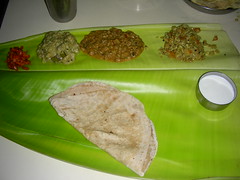
    I had also heard about Mani's Lunch Home in Matunga, but had never been there. When I searched on the web, I came to know that it is the first and oldest authentic Aiyer restaurant in Mumbai. Of course, it had to be in Matunga. They have come up with branches later, but began in Matunga. And, on one fine Saturday, Hari persuaded all of us to go to Mani's to savour the authentic Aiyer food. And we had a meal of our life. Served on a plantain leaf, in traditional Aiyer style, the food consists of the typical South Indian menu of dry vegetable, curry vegetable, pickle, papad, curd, butter-milk, sambhar, rasam and rice. And it goes without saying, that you can devour in as much quantity as you can. As it is a very busy restaurant, the food served is always hot. The chapatis are served fresh off the pan. The sambhar and rasam have a typical Aiyer taste to it. They source the rice from South India itself. The kind of rice used in the restaurant is not native to Maharashtra. But, it is a nice variety and the rice is well cooked and has a soft, spongy feeling to it.

    Having Hari with us, gave us a language advantage. Hari used all his knowledge of Tamil language to get us an express seat and good service. Otherwise, the service standard in Mani's is not as good as Rama Nayak. Of course, we were first timers in the restaurant and patrons must be getting better treatment. But then, they also have to focus on converting first timers into patrons. That they cannot do only by serving good food. Sometimes you are kept waiting for the next serving of vegetables and sometimes you are deluged with the waiters wanting to serve you.

    But overall, Mani's was a satisfying experience. We ate so much that it would have been very nice to have an acquaintance in Matunga. We somehow managed to get back to IIT. That to we took a rickshaw from Kanjur to the hostel. And in the hostel, we slept soundly for more than an hour. The evening saw us having very less dinner, as we were still savouring the tastes of Mani's.
    Mani's Lunch HomeSocialTwist Tell-a-Friend